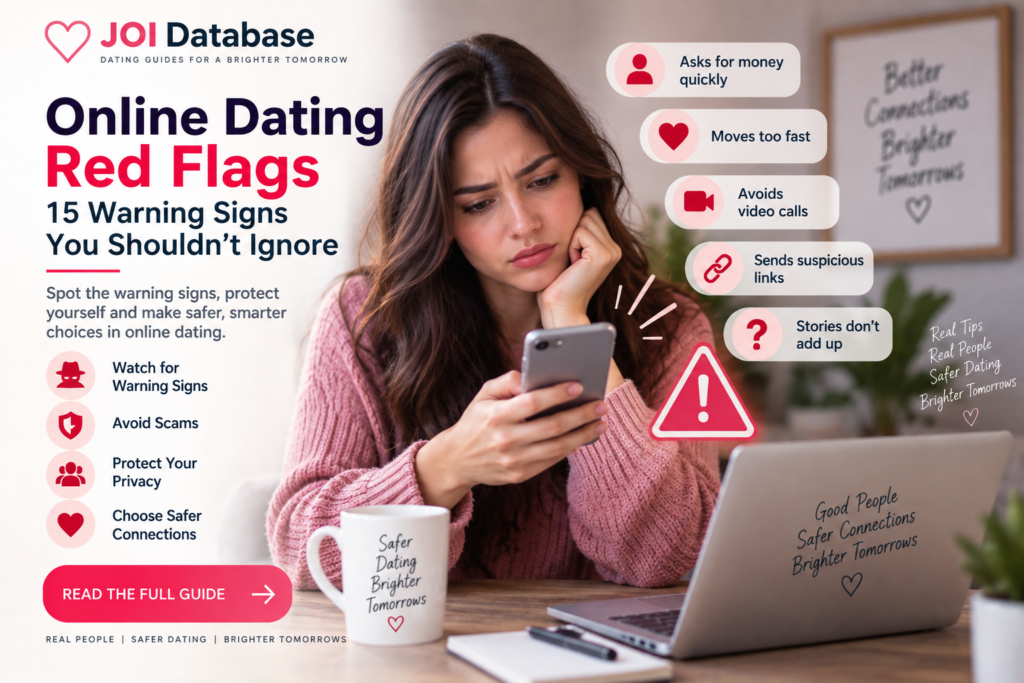
Online dating can introduce you to interesting people, but not every interaction deserves your trust. Some warning signs are obvious, while others may appear only after several conversations.
A red flag does not always prove that someone has bad intentions. Context matters. However, repeated dishonesty, pressure, manipulation, financial requests, or disrespect for your boundaries are good reasons to become more cautious.
Learning to recognize common online dating red flags can help you make more informed decisions about who you communicate with and what information you share.
1. Their Stories Keep Changing
Small differences in someone’s story can happen naturally. People forget details or explain the same experience differently.
Repeated contradictions are different.
For example, pay attention if important information about someone’s:
- Identity
- Location
- Relationship status
- Employment
- Family situation
- Reasons for using a dating platform
changes significantly from one conversation to another.
You do not need to investigate every minor inconsistency, but a pattern of conflicting stories deserves attention.
2. They Ask for Money
Financial requests are one of the clearest reasons to become cautious.
Someone may claim they suddenly need money because of:
- A medical emergency
- Travel problems
- A frozen bank account
- A family emergency
- An unpaid bill
- A business opportunity
- An investment
- An unexpected legal problem
A dramatic story can feel convincing, especially after weeks of emotional conversations.
Do not allow emotional pressure to override basic financial caution.
Avoid sending money, gift cards, cryptocurrency, banking information, card details, passwords, or verification codes to someone you know only through online dating.
3. The Relationship Becomes Extremely Serious Very Quickly
Excitement at the beginning of a new connection is normal.
However, be cautious when someone you barely know immediately makes unusually intense promises or declarations.
Examples might include talking about marriage after a very short time, claiming you are their perfect partner before really knowing you, or pushing for an immediate commitment.
Strong emotions are not automatically suspicious.
The concern is when intense affection is combined with pressure, financial requests, isolation, or attempts to make you ignore reasonable questions.
Healthy connections generally allow both people time to learn about each other.
4. They Avoid Reasonable Video Communication
Not everyone enjoys video calls, and privacy concerns can be legitimate.
But repeated excuses may deserve additional consideration when someone is presenting themselves as a potential romantic partner while refusing every reasonable opportunity to verify that they resemble their profile.
A video call does not prove someone’s intentions or identity.
It can, however, provide another piece of information when deciding whether you are comfortable moving forward.
5. Their Profile and Conversation Do Not Match
Pay attention to significant inconsistencies between a person’s profile and what they tell you privately.
For example, their profile might describe one location, occupation, age range, or relationship goal while their messages repeatedly suggest something different.
A profile may simply be outdated.
Ask reasonable questions rather than immediately assuming dishonesty.
If explanations continually create more contradictions, proceed cautiously.
6. They Pressure You to Leave the Dating Platform Immediately
Moving a conversation to another messaging service is common and is not automatically a warning sign.
Pressure is the important distinction.
Be cautious when someone insists that you immediately:
- Give them your phone number
- Move to an unfamiliar messaging service
- Delete your dating profile
- Communicate only through a private channel
- Stop using the platform’s reporting tools
Staying on the dating platform initially may give you access to blocking, reporting, and other safety features.
You should be able to decide when you are comfortable sharing additional contact information.
7. They Want Sensitive Personal Information
Getting to know someone naturally involves sharing information.
However, a new dating contact generally does not need access to sensitive details such as:
- Banking information
- Passwords
- One-time passwords
- Government identification numbers
- Exact financial information
- Account recovery information
- Your home address immediately
- Security-question answers
Be particularly cautious if someone creates an urgent reason why you supposedly need to provide this information.
8. They Send Suspicious Links
Unexpected links can expose you to phishing pages, fake login screens, malicious downloads, or fraudulent payment sites.
Be cautious when someone asks you to click a link to:
- Verify your dating identity
- Confirm your age with a credit card
- Claim a gift
- Receive money
- Make an investment
- Download an unknown application
- Log in to an unfamiliar website
If you need to access a legitimate service, navigate to its official website or application independently instead of relying on an unexpected link.
9. They Pressure You for Private or Intimate Material
You should never feel pressured to send photographs, videos, or other private material.
Once digital material has been shared, controlling where it goes can become difficult.
Pressure, threats, manipulation, or repeated requests after you have said no are serious warning signs.
Do not allow someone to convince you that sending private material is necessary to prove affection or trust.
A person who respects you should also respect your boundaries.
10. They Become Angry When You Set Boundaries
Boundaries can involve many things:
- When you meet
- Where you meet
- What information you share
- Physical contact
- Communication frequency
- Financial matters
- Your availability
Someone does not have to agree with every decision you make, but intimidation, insults, threats, or manipulation in response to a reasonable boundary deserve attention.
Respect should exist even when two people want different things.
11. They Refuse to Meet but Continually Make Promises
There are many legitimate reasons why people cannot meet immediately, particularly when distance is involved.
The potential warning sign is an ongoing pattern.
Someone may repeatedly promise to meet and then cancel at the last moment with increasingly dramatic explanations.
This becomes more concerning when cancellations are combined with requests for travel money, emergency assistance, gift cards, or other financial support.
Judge patterns rather than a single cancelled meeting.
12. Their Life Seems to Be a Continuous Emergency
Everyone experiences difficult periods.
But repeated emergencies can sometimes be used to create urgency and discourage careful thinking.
Be cautious if nearly every conversation eventually leads to another crisis requiring your:
- Money
- Account information
- Financial assistance
- Immediate action
- Secrecy
You can care about someone’s situation without taking financial risks for a person you have not independently come to trust.
13. They Promote a “Guaranteed” Investment
Dating conversations can sometimes shift into discussions about cryptocurrency, trading, investment platforms, or business opportunities.
Be particularly careful if a romantic contact claims to have a guaranteed way to make money.
Warning signs include:
- Guaranteed profits
- Pressure to invest quickly
- Requests to transfer cryptocurrency
- An unfamiliar investment website
- Claims that only they can help you access an opportunity
- Pressure to increase your investment after an apparent early profit
Romantic trust should never substitute for independent financial due diligence.
14. They Try to Isolate You From Other People
A new relationship should not require you to abandon trusted friends or family.
Be cautious if someone repeatedly tells you:
- Not to discuss the relationship with anyone
- That everyone close to you is against your happiness
- That only they understand you
- To ignore concerns raised by people you trust
Privacy between two people can be reasonable.
Secrecy demanded as a condition of the relationship is different.
Maintaining connections with trusted people can help you retain perspective.
15. Something Consistently Does Not Feel Right
Not every concern fits neatly into a checklist.
You might notice several small inconsistencies that individually seem harmless but together make you uncomfortable.
You do not need definitive proof of wrongdoing to slow down an online relationship.
You can:
- Ask more questions
- Share less personal information
- Delay meeting
- Decline financial requests
- Stop communicating
- Block an account
- Report suspicious behavior
Your participation in a dating conversation is voluntary.
Red Flag vs. Normal Dating Behavior
It is important not to treat every inconvenience or personality difference as evidence of a scam.
This quick comparison can help provide perspective:
| Situation | Usually Normal | Reason for More Caution |
|---|---|---|
| Reply time | Sometimes replies late | Uses silence to pressure or manipulate you |
| Video calls | Feels nervous initially | Consistently refuses while identity concerns grow |
| Meeting | Reschedules once | Repeatedly cancels and asks for money |
| Personal information | Shares gradually | Demands sensitive details immediately |
| Affection | Interest develops naturally | Extreme commitment almost immediately |
| Money | Discusses everyday finances generally | Requests transfers, gift cards or cryptocurrency |
| Boundaries | Accepts your decision | Becomes threatening or manipulative |
| Communication app | Suggests another app | Pressures you to leave the dating platform immediately |
No table can determine someone’s intentions with certainty. Look at the overall pattern of behavior.
What Should You Do When You Notice a Red Flag?
The appropriate response depends on the situation.
Slow the Conversation Down
You do not need to make an immediate decision about a new relationship.
Take additional time before sharing personal information or making commitments.
Ask Reasonable Questions
If something does not make sense, ask about it.
Pay attention not only to the answer but also to whether explanations remain reasonably consistent.
Protect Your Accounts
Never share passwords, one-time verification codes, banking credentials, or account recovery information.
Do Not Send Money
Emotional connection does not make an unfamiliar financial request safe.
Use Platform Safety Tools
Block or report an account when appropriate.
Dating platforms may be able to investigate suspicious behavior that individual users cannot.
Talk to Someone You Trust
A friend or family member may notice concerns that are harder to recognize when you are emotionally involved.
An outside perspective can be useful.
Leave When Necessary
You are allowed to stop communicating.
You do not owe continued access to someone who repeatedly ignores your boundaries or makes you feel unsafe.
If You Plan to Meet in Person
Online red flags become particularly important when a conversation moves toward an in-person meeting.
For an initial meeting, consider:
- Choosing a public location
- Arranging your own transportation
- Keeping your phone charged
- Telling a trusted person where you are going
- Avoiding unnecessary disclosure of your home address
- Leaving if you become uncomfortable
A first meeting should not require you to surrender control over your transportation, privacy, or boundaries.
Frequently Asked Questions
What is a red flag in online dating?
A red flag is behavior or information that gives you a reasonable reason to become more cautious. Examples can include repeated dishonesty, financial requests, pressure for sensitive information, manipulation, threats, or disregard for boundaries.
Is refusing a video call always a red flag?
No. Some people are uncomfortable with video communication or may have legitimate privacy concerns. Repeated refusal becomes more relevant when it appears alongside identity inconsistencies, financial requests, or other suspicious behavior.
What should I do if someone I met online asks for money?
Avoid sending money or providing financial credentials. Be particularly cautious about gift cards, cryptocurrency transfers, banking information, passwords, and verification codes.
Is moving from a dating app to another messaging app unsafe?
Not necessarily. Many genuine users eventually communicate elsewhere. The warning sign is pressure to move immediately or attempts to prevent you from using the dating platform’s safety and reporting features.
Should I report a suspicious dating profile?
If you reasonably suspect impersonation, fraud, harassment, threats, or another violation of the platform’s rules, consider using its reporting feature. You can also block the account when appropriate.
Can a verified dating profile still be risky?
Verification features can provide useful information, but they should not be treated as a guarantee of someone’s intentions or future behavior. Continue protecting personal and financial information even when a profile has been verified.
A Simple Rule to Remember
Online dating safety does not require you to become suspicious of everyone.
Instead, focus on whether someone’s behavior consistently demonstrates honesty, patience, and respect.
A genuine connection should not require you to:
- Send money
- Reveal passwords
- Provide verification codes
- Ignore your boundaries
- Keep dangerous secrets
- Make immediate commitments
- Take financial risks
When pressure replaces respect, slowing down is usually sensible.
Final Thoughts
Online dating red flags are most useful when considered as patterns rather than isolated incidents.
One delayed reply or cancelled meeting does not necessarily mean anything is wrong. Repeated contradictions, requests for money, manipulation, pressure for sensitive information, and disrespect for boundaries are much more significant.
Take your time, protect your personal information, keep financial decisions separate from romantic pressure, and use blocking or reporting tools when necessary.
A healthy connection should give you room to think and make your own decisions.
JOI Database provides independent informational content about dating, relationships, first dates, and online safety. It does not operate public dating profiles or provide matchmaking services.